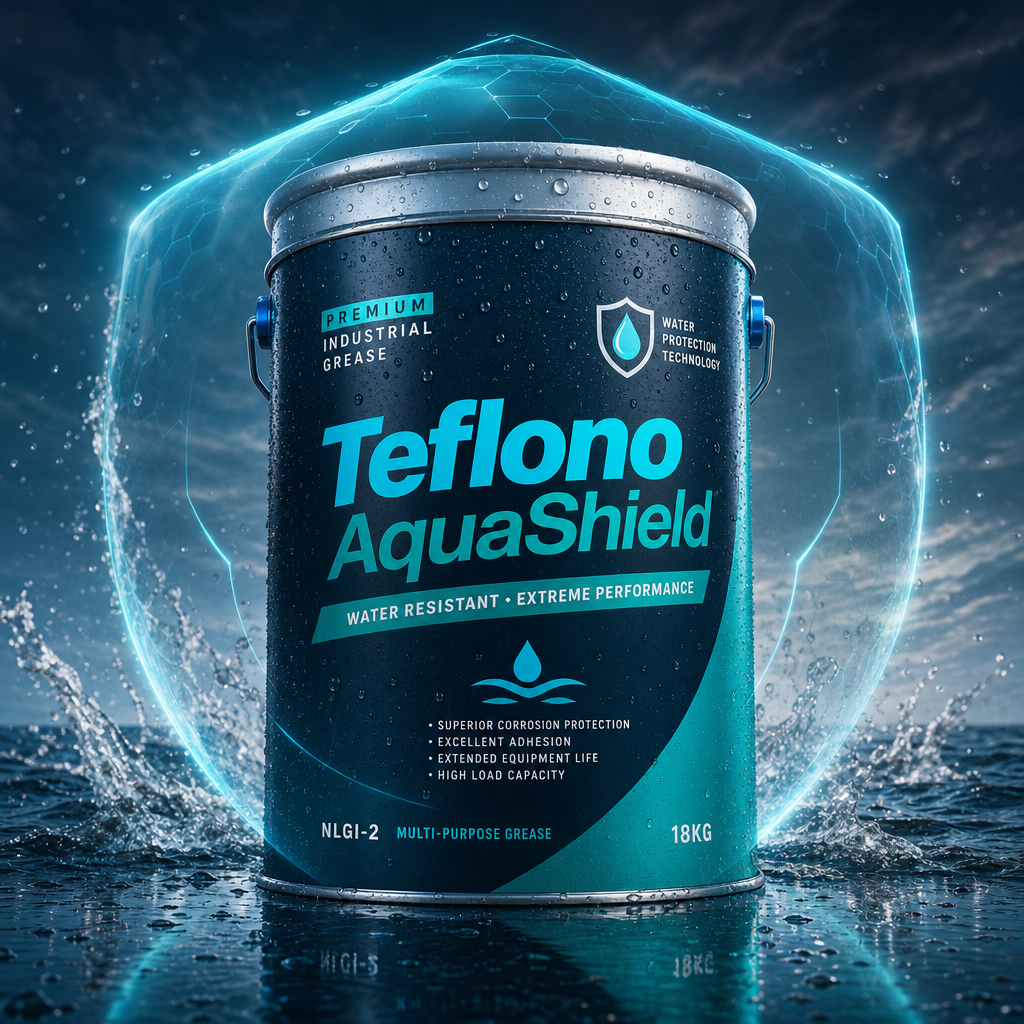
Teflono AquaShield
Advanced PTFE barrier grease for submersible and splash-zone applications
AquaShield is engineered for equipment that operates submerged or in constant contact with water. Its unique aluminum complex thickener combined with hydrophobic PTFE particles creates an impenetrable moisture barrier. The synthetic ester base oil provides biodegradability for environmentally sensitive marine applications, while the high tackifier content ensures the grease stays in place even under water pressure. A dual aminic/phenolic antioxidant package provides excellent oxidation stability for extended underwater service life.
Temp Range
-40°C — 180°C
PTFE Content
20%
Base Oil
Synthetic Ester (Biodegradable)
NLGI Grade
2
Technical Data Sheet
Specifications
Additives
Key Features
- Superior water resistance for submerged and splash-zone use
- 20% PTFE creates an impenetrable hydrophobic barrier
- Biodegradable synthetic ester base oil for eco-sensitive areas
- Aluminum complex thickener resists water washout — drop point >305°C
- Dual aminic/phenolic antioxidant system for excellent oxidation stability
- VCI additives protect metal surfaces from vapor-phase corrosion
- Operates from -40°C to 180°C for all-climate marine service
Applications & Use Cases
Performance Characteristics
Manufacturing Recipe
Batch size: 1kg — Detailed formulation and step-by-step process
Ingredients (1kg batch)
| Ingredient | % | Grams | Role |
|---|---|---|---|
| Synthetic Ester Base Oil (TMP Ester) | 38% | 380g | Biodegradable base lubricant — excellent water separation |
| Aluminum Complex Thickener | 12% | 120g | Water-resistant thickener with excellent adhesion |
| PTFE Micro-powder (3μm) | 20% | 200g | Hydrophobic solid lubricant — repels water at boundary surfaces |
| Aluminum Stearate | 4% | 40g | Co-thickener and water repellent |
| Hydrophobic Fumed Silica | 5% | 50g | Reinforcing agent and moisture barrier enhancer for superior water resistance |
| Polyalphaolefin Tackifier | 5% | 50g | High-adhesion tackifier — prevents underwater washout |
| VCI (Dicyclohexylamine Nitrite) | 2% | 20g | Vapor phase corrosion inhibitor |
| Bismuth Dithiocarbamate EP Additive | 3% | 30g | Non-toxic extreme pressure protection (replaces lead/antimony) |
| Diphenylamine Antioxidant | 2% | 20g | Primary aminic antioxidant — radical scavenger for long-term protection |
| Hindered Phenol Anti-oxidant (BHT) | 1.5% | 15g | Secondary phenolic antioxidant — synergistic with aminic for excellent oxidation stability |
| Fluorosilicone Anti-foam | 1% | 10g | Controls foam in water-contaminated operation |
| Benzoic Acid (pH buffer) | 3.5% | 35g | Controls grease pH and assists aluminum complex formation |
| PAO 6 Co-base Oil | 3% | 30g | Co-base oil for improved low-temperature performance |
Process Steps
Ester Oil Preparation
Heat TMP synthetic ester oil in a clean stainless steel vessel. Synthetic esters are hygroscopic — ensure oil is dry (<100 ppm moisture) before starting. Pre-dry if necessary by heating to 110°C under vacuum for 30 minutes. Blend with PAO 6 co-base oil.
Aluminum Complex Formation
Add aluminum complex thickener and aluminum stearate to the heated oil. Add benzoic acid as complexing agent. Heat to reaction temperature while stirring at 800 RPM. The mixture will progressively thicken as the aluminum soap complex forms.
Structure Development
Hold at 190°C for the aluminum complex to fully develop its gel structure. The grease should have a clear, translucent appearance. Cool slowly — rapid cooling can create a lumpy, inconsistent structure.
PTFE & Silica Loading
At 130°C, add PTFE micro-powder first at 1000 RPM. Once dispersed, add hydrophobic fumed silica (5% loading — higher than standard to ensure superior water resistance). Continue mixing until completely smooth.
Dual Antioxidant, Tackifier & Additives
At 100°C, add diphenylamine and hindered phenol antioxidants (dual system provides excellent oxidation stability through synergistic radical scavenging). Add PAO tackifier (will increase stringiness significantly). Then add VCI, bismuth EP additive, and anti-foam. Mix each for 3 minutes.
Milling & Water Immersion Test
Mill through a three-roll mill twice. Perform water immersion test: submerge a greased bearing in water for 48 hours, then inspect for washout and corrosion. Also perform water spray-off test.
QC, Certification & Packaging
Full QC per marine specifications. Test biodegradability (OECD 301B), drop point (>305°C), oxidation stability (excellent grade), and four-ball wear (<0.42 mm). Package in sealed marine-grade cartridges and tubes with moisture-barrier packaging.
Required Equipment
- Stainless steel reactor with heating jacket and condenser
- Variable speed agitator (100–1200 RPM)
- Vacuum system for oil drying
- Three-roll mill
- Water immersion test tank
- Moisture analyzer (Karl Fischer)
- Marine-grade packaging equipment
- PPE: Safety glasses, nitrile gloves, lab coat
Safety Notes
- Synthetic ester oil can cause mild skin irritation — wear gloves
- Aluminum stearate dust is a respiratory irritant — use dust mask
- VCI (dicyclohexylamine nitrite) is harmful if swallowed — handle carefully
- Benzoic acid is a mild irritant — avoid contact with eyes
- The finished product meets marine biodegradability requirements
- Dispose of waste esters through licensed waste oil recycling
Quality Control Checks
- Cone penetration: 265–295 dmm (ASTM D217)
- Drop point: >305°C (ASTM D2265)
- Water washout @79°C: <0.5% (ASTM D1264)
- Water spray-off: <3% (ASTM D4049)
- Four-ball wear scar: <0.42 mm (ASTM D2266)
- Oxidation stability: >280 min at 100°C (ASTM D942)
- Biodegradability: >60% in 28 days (OECD 301B)
- Visual: Translucent, slightly blue-tinted, very tacky gel