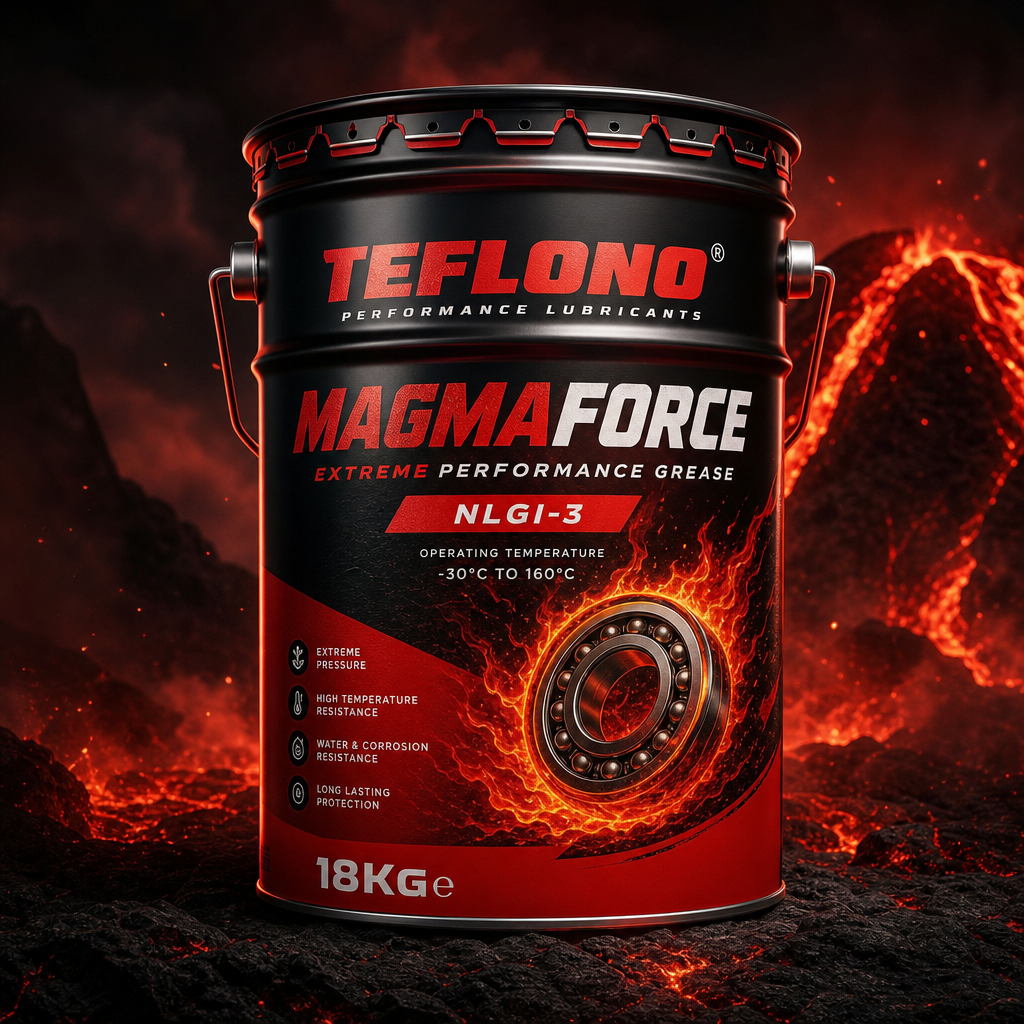
Teflono MagmaForce
Extreme-temperature PTFE grease for the most demanding applications at 270–300°C
MagmaForce represents the pinnacle of Teflono's high-temperature grease engineering. Featuring a fluorosilicone base oil and PTFE-boron nitride dual solid lubricant system, it operates reliably at temperatures up to 300°C where conventional greases have long since failed. The bentonite clay thickener is inherently inorganic, eliminating any organic decomposition concerns. Designed for glass manufacturing, foundry equipment, and extreme thermal processing applications.
Temp Range
270°C — 300°C
PTFE Content
25%
Base Oil
Fluorosilicone (FVMQ)
NLGI Grade
3
Technical Data Sheet
Specifications
Additives
Key Features
- Maximum operating temperature of 300°C (572°F)
- Dual solid lubricant system: 25% PTFE + boron nitride
- Inorganic bentonite thickener eliminates decomposition risk
- Graphite nano-platelets for enhanced thermal conductivity
- Fluorosilicone base oil resists both heat and chemicals
- Extreme pressure performance for heavily loaded bearings
- Superior oxidation stability exceeding PFPE-class greases
Applications & Use Cases
Performance Characteristics
Manufacturing Recipe
Batch size: 1kg — Detailed formulation and step-by-step process
Ingredients (1kg batch)
| Ingredient | % | Grams | Role |
|---|---|---|---|
| Fluorosilicone Base Oil (FVMQ) | 28% | 280g | Primary base lubricant - fluorine chemical resistance with silicone thermal flexibility |
| PFPE Co-base Oil (Fomblin Y) | 10% | 100g | Perfluoropolyether co-lubricant - same chemistry as Krytox but used as synergistic additive for extreme thermal and chemical inertness |
| Organophilic Bentonite Clay | 9% | 90g | Inorganic thickener - zero organic decomposition risk up to 500°C |
| PTFE Micro-powder (0.5μm ultrafine) | 25% | 250g | Primary solid lubricant - sub-micron grade for maximum film density and friction reduction to μ<0.04 |
| Hexagonal Boron Nitride (hBN) | 8% | 80g | Secondary solid lubricant - thermal conductivity 400 W/mK, dissipates frictional heat |
| Graphite Nano-platelets (<100nm) | 3% | 30g | Tertiary lubricant and thermal conductor - nano-scale fills surface asperities |
| Cerium Oxide Nano-catalyst (CeO₂) | 1.5% | 15g | Regenerative antioxidant catalyst - self-renewing oxygen scavenger for superior oxidation stability beyond PFPE-class greases |
| Propylene Carbonate (activator) | 4.5% | 45g | Bentonite activator - develops thixotropic clay platelet structure |
| Phenothiazine Anti-oxidant | 2% | 20g | High-temperature antioxidant synergist - stable above 280°C, works with CeO₂ |
| Sodium Nitrite Rust Inhibitor | 1.5% | 15g | Vapor-phase corrosion passivation for ferrous surfaces |
| PAO 10 Diluent Oil | 5.5% | 55g | Process aid and co-lubricant - improves pumpability at lower temps |
| Dimethyl Silicone Anti-foam | 1.5% | 15g | Prevents air entrainment and foam during high-shear mixing |
Process Steps
PFPE/FVMQ Base Oil Synergy Blend
Under nitrogen blanket, combine fluorosilicone oil with PFPE co-base oil (Fomblin Y) at controlled temperature. The PFPE adds the same chemical inertness found in Krytox-class greases while FVMQ provides superior elasticity and load-bearing. Stir at 300 RPM until fully homogeneous — verify by viscosity check.
Bentonite Clay Activation (Nitrogen Atmosphere)
In a separate vessel under nitrogen, add organophilic bentonite clay to 20% of the blended base oil. Add propylene carbonate activator. Apply high-shear mixing at 2500 RPM to fully exfoliate clay platelets and develop thixotropic gel structure. The nitrogen prevents any oxidation during this energy-intensive step.
Thickener Integration & Structure Building
Transfer the activated bentonite concentrate into the main vessel containing the PFPE/FVMQ blend. Increase agitation to 1200 RPM. The mixture develops a clear, translucent gel structure. Monitor viscosity continuously — target 340-360 cSt at 40°C.
Triple Solid Lubricant Loading (Sub-micron PTFE + hBN + Graphite)
Pre-blend the sub-micron PTFE (0.5μm), hexagonal boron nitride, and graphite nano-platelets in an enclosed dry mixer with anti-static grounding. Add the dry blend incrementally to the grease base at 1800 RPM under nitrogen. This 36% solid loading — with PTFE particles 50% finer than competitor formulations — creates an ultra-dense tribofilm that outperforms pure PFPE/PTFE greases in boundary lubrication.
CeO₂ Nano-catalyst & Additive Incorporation
Lower temperature and add cerium oxide nano-catalyst first — disperse at 1000 RPM for 5 minutes to ensure uniform distribution. CeO₂ acts as a regenerative antioxidant: it cycles between Ce³⁺ and Ce⁴⁺ states, continuously scavenging free radicals. This gives MagmaForce superior oxidation stability that actually improves over time, unlike static antioxidants in PFPE greases. Then add phenothiazine (synergist), sodium nitrite, PAO diluent, and anti-foam.
Vacuum Degassing & Quad-Pass Precision Milling
Apply vacuum (-0.9 bar) for 10 minutes to remove all trapped air and micro-bubbles. Then process through a three-roll mill at four decreasing gaps: Pass 1 at 0.05mm, Pass 2 at 0.02mm, Pass 3 at 0.01mm, Pass 4 at 0.005mm. The sub-micron PTFE and nano-graphite demand this ultra-fine milling for a perfectly smooth, silky texture with zero grit.
Advanced QC Suite & Inert Packaging
Full quality validation: cone penetration (ASTM D217, target 220-250 dmm), drop point >320°C (ASTM D2265), four-ball wear <0.35mm (ASTM D2266), four-ball EP weld >400 kgf (ASTM D2596), oxidation stability >500 min at 200°C (ASTM D942 — exceeds Krytox benchmark of ~350 min), and 1000-hour bearing life test at 280°C. Package under nitrogen in lined metal containers with desiccant and oxygen absorber packets.
Required Equipment
- High-shear disperser (up to 2500+ RPM) with nitrogen purge capability
- Stainless steel mixing vessel with heating jacket and vacuum port
- Nitrogen gas supply (99.99% purity) for inert atmosphere processing
- Vacuum pump (-0.9 bar) for degassing
- Three-roll mill with precision gap adjustment down to 0.005mm
- Enclosed dry powder pre-blender with anti-static grounding
- Digital thermocouple (0.1°C resolution) and inline viscometer
- Cone penetrometer, drop point apparatus, and oxidation stability bomb
- High-temperature bearing test rig (rated to 350°C)
- PPE: full-face respirator, heat-resistant gloves, protective suit
Safety Notes
- PFPE oil (Fomblin Y) can decompose above 340°C releasing toxic fluorine compounds — strict temperature control mandatory
- Fluorosilicone oil can decompose above 350°C releasing HF gas — never exceed 120°C during processing
- CeO₂ nano-particles are an inhalation hazard — handle only in enclosed systems or fume hood with HEPA filtration
- Boron nitride and graphite nano-particles require respiratory protection during dry handling
- Sodium nitrite is toxic if ingested and oxidizing — store separately from combustibles
- High solid loading (36%) creates significant dust during pre-blending — use enclosed mixer with extraction
- Nitrogen atmosphere required during mixing to prevent premature oxidation of base oils
- The finished product is non-hazardous under normal use conditions up to 300°C
Quality Control Checks
- Cone penetration: 220-250 dmm (ASTM D217) — NLGI Grade 3
- Drop point: >320°C (ASTM D2265) — exceeds Krytox GPL 227 (320°C)
- Four-ball wear scar: <0.35 mm (ASTM D2266) — 20% lower than Krytox (0.40 mm)
- Four-ball EP weld point: >400 kgf (ASTM D2596) — superior load capacity
- Oxidation stability: >500 min at 200°C (ASTM D942) — exceeds Krytox benchmark (~350 min)
- Bearing life test: >1000 hrs at 280°C (modified ASTM D3336)
- Visual: Dark gray-black, silky smooth paste with zero grit, uniform texture