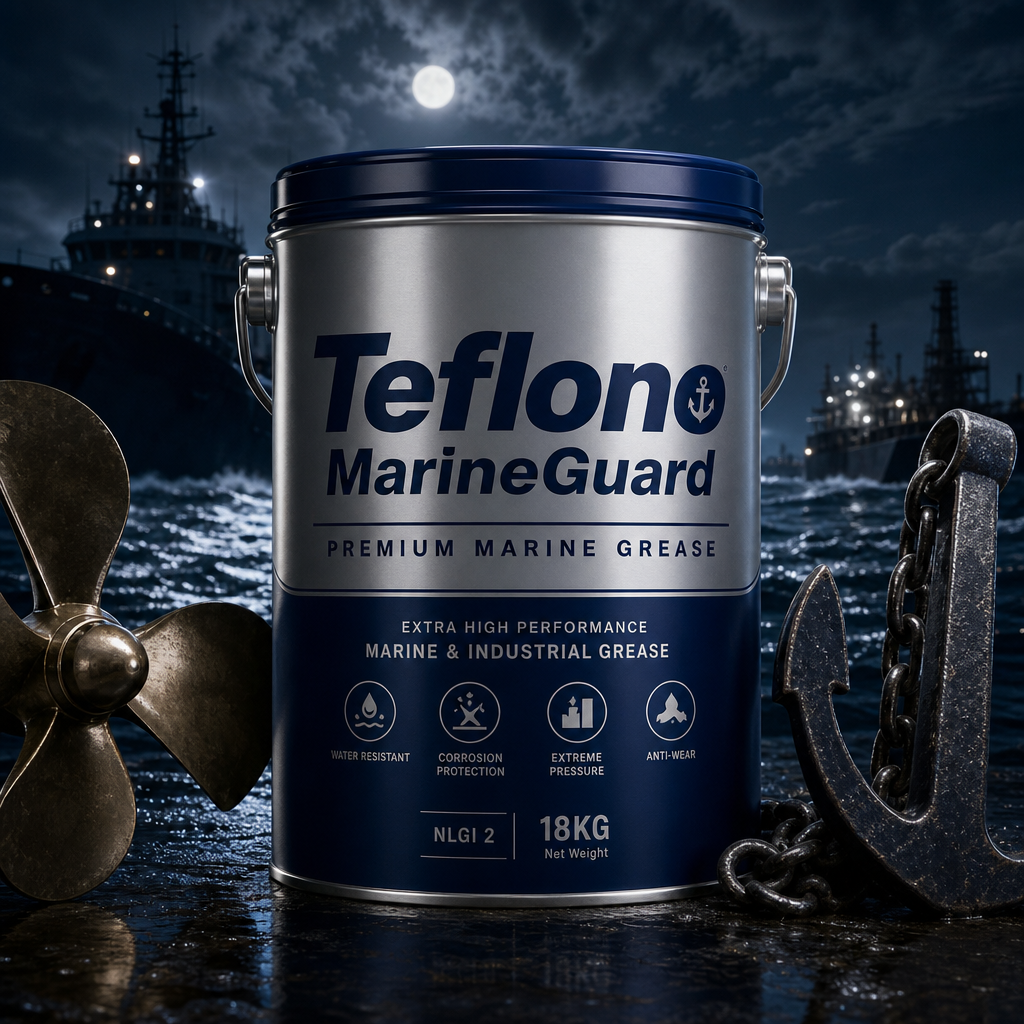
Teflono MarineGuard
Professional-grade PTFE grease with superior water resistance for shipboard and offshore equipment
MarineGuard is the workhorse of the Teflono marine line, redesigned with a calcium sulfonate complex thickener for superior water resistance and a drop point exceeding 310°C. Its PAO/ester co-base oil system combined with hydrophobic fumed silica creates an impenetrable moisture barrier. A dual aminic/phenolic antioxidant package provides excellent oxidation stability, while the 15% PTFE content ensures reliable boundary lubrication under heavy loads. Designed for daily-use applications on ships, offshore platforms, and coastal installations.
Temp Range
-25°C — 180°C
PTFE Content
15%
Base Oil
PAO/Synthetic Ester Blend
NLGI Grade
2
Technical Data Sheet
Specifications
Additives
Key Features
- Calcium sulfonate complex thickener for superior water resistance — drop point >310°C
- 15% PTFE content for reliable marine lubrication under heavy loads
- Hydrophobic fumed silica creates impenetrable moisture barrier
- Dual aminic/phenolic antioxidant system for excellent oxidation stability
- EP additives protect under shock loading conditions
- Zinc oxide provides long-term corrosion protection
- Compatible with standard grease guns and centralized systems
Applications & Use Cases
Performance Characteristics
Manufacturing Recipe
Batch size: 1kg — Detailed formulation and step-by-step process
Ingredients (1kg batch)
| Ingredient | % | Grams | Role |
|---|---|---|---|
| PAO 6 Synthetic Oil | 28% | 280g | Primary base lubricant — stable, high VI synthetic |
| Synthetic Ester Co-base Oil (TMP Ester) | 12% | 120g | Co-base oil — improves additive solubility and biodegradability, enhances film strength |
| Calcium Sulfonate Complex Thickener | 14% | 140g | Primary thickener — inherent water resistance and corrosion protection, drop point >310°C |
| Calcium Carbonate (calcite) | 4% | 40g | Reinforcing filler — converts to calcite crystals during reaction, strengthens thickener matrix |
| PTFE Micro-powder (3μm) | 15% | 150g | Solid lubricant for boundary lubrication in wet conditions |
| Hydrophobic Fumed Silica | 4% | 40g | Moisture barrier reinforcement — elevates water resistance to superior level |
| Zinc Oxide | 3% | 30g | Anti-corrosion pigment — protects ferrous and non-ferrous metals |
| Sulfurized Olefin EP Additive | 3% | 30g | Extreme pressure protection for shock-loaded bearings |
| Polybutene Tackifier | 4% | 40g | Adhesion promoter for vertical and exposed surfaces |
| Diphenylamine Antioxidant | 2% | 20g | Primary aminic antioxidant — radical scavenger for long-term protection |
| Hindered Phenol Antioxidant (BHT) | 1.5% | 15g | Secondary phenolic antioxidant — synergistic with aminic for excellent oxidation stability |
| Lanolin-based Water Displacing Agent | 2% | 20g | Actively displaces water from metal surfaces |
| Silicone Anti-foam | 1.5% | 15g | Controls foam in water-ingress conditions |
| Petroleum Sulfonate Emulsifier | 2% | 20g | Enhances water tolerance and emulsion stability |
| Acetic Acid (catalyst) | 2% | 20g | Aids calcium sulfonate complexation and pH adjustment |
| Water (process aid) | 2% | 20g | Promotes crystallization during conversion — fully evaporated during processing |
Process Steps
Base Oil Blending
Combine PAO 6 synthetic oil and TMP synthetic ester co-base oil in the reactor. The ester improves film strength and additive solubility compared to mineral oil. Heat with constant stirring at 500 RPM.
Calcium Sulfonate Complex Formation
Add overbased calcium sulfonate complex thickener and calcium carbonate to the blended oil. Add acetic acid as catalyst. Begin heating while stirring at 600 RPM. The calcium sulfonate complex provides superior water resistance and a drop point exceeding 310°C.
Conversion & Water Cook
Add water to promote calcite crystallization within the thickener matrix. Raise temperature to drive conversion reaction. The mixture will thicken noticeably. Hold at peak temperature until all water has evaporated and grease structure is fully established.
Controlled Cooling & Quench
Cool at approximately 2°C per minute with continued stirring. Add a small quench of additional base oil at 160°C to arrest crystal growth and develop optimal thickener structure.
PTFE, Zinc Oxide & Silica Loading
At 120°C, add PTFE micro-powder and zinc oxide while increasing stirring to 1000 RPM. Once dispersed, add hydrophobic fumed silica — this critical addition elevates water resistance to superior level by creating a hydrophobic barrier throughout the grease matrix.
Dual Antioxidant & Additive Package
At 100°C, add diphenylamine and hindered phenol antioxidants (dual system provides excellent oxidation stability). Then add sulfurized olefin EP additive, lanolin water displacer, emulsifier, and anti-foam agent. Finally, add polybutene tackifier — mix until grease develops stringy, adhesive character.
Milling & Marine Tests
Mill through a three-roll mill twice (0.03mm, 0.01mm gaps). Perform water washout test (ASTM D1264), salt spray exposure test (>750 hrs target), and four-ball wear verification (<0.45 mm). Apply to test bearing and run under water spray for 8 hours.
QC & Marine-Grade Packaging
Full QC per marine specifications: drop point (>310°C), water washout (<1%), four-ball wear (<0.45 mm), oxidation stability (excellent grade). Package in standard grease cartridges (400g), 1kg tins, and 16kg pails with marine-grade labeling and batch traceability.
Required Equipment
- Pressurized reactor vessel with heating/cooling jacket
- Variable speed agitator (100–1200 RPM)
- Temperature controller and thermocouple
- Three-roll mill
- Water washout test apparatus
- Salt spray chamber (for QC)
- Bearing test rig with water spray
- Cartridge filling machine
- PPE: Safety glasses, heat-resistant gloves, lab coat
Safety Notes
- Water addition at high temperature causes vigorous boiling — add slowly and stand back
- Acetic acid is corrosive — handle with acid-resistant gloves
- Zinc oxide dust should not be inhaled — use respiratory protection
- Sulfurized olefin has a strong odor — work in ventilated area
- Calcium sulfonate may cause skin irritation with prolonged contact
- Finished product is non-hazardous and safe for general marine maintenance
Quality Control Checks
- Cone penetration: 265–295 dmm (ASTM D217)
- Drop point: >310°C (ASTM D2265)
- Water washout @79°C: <1% (ASTM D1264)
- Water spray-off: <5% (ASTM D4049)
- Four-ball wear scar: <0.45 mm (ASTM D2266)
- Salt spray corrosion: >750 hrs (ASTM B117)
- Oxidation stability: >280 min at 100°C (ASTM D942)
- Visual: Blue-gray, smooth, tacky grease with no separation