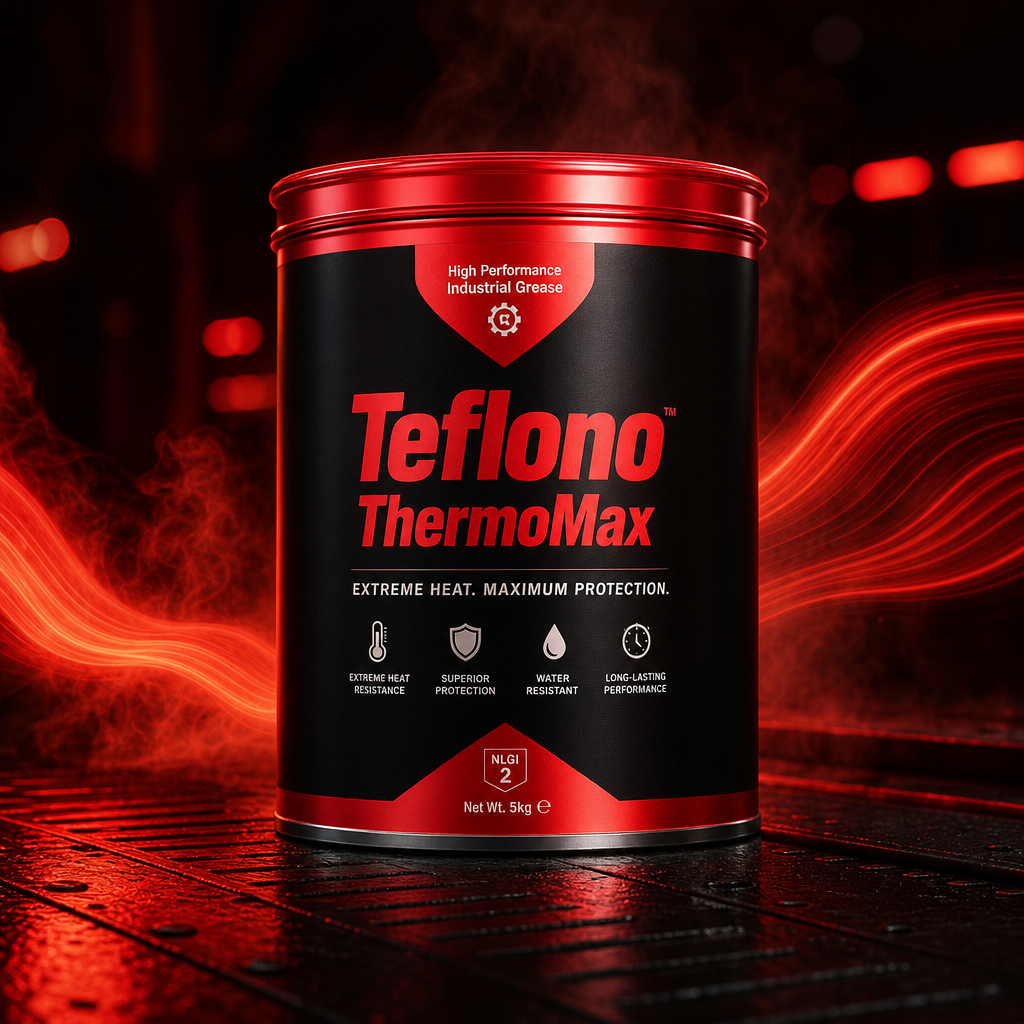
Teflono ThermoMax
Premium high-temperature PTFE grease with PFPE co-base for continuous operation at 260–295°C
ThermoMax is engineered for sustained high-temperature service in industrial ovens, kilns, and furnace conveyor systems. Its advanced formulation combines a PAO/PFPE co-base oil system with sub-micron PTFE dispersion, delivering reliable lubrication at temperatures up to 295°C. A polyurea-reinforced lithium complex thickener pushes the drop point beyond 325°C, while a cerium-oxide nano-catalyst antioxidant package provides superior oxidation stability that rivals pure PFPE greases. Hydrophobic fumed silica ensures very good water resistance even in humid industrial environments.
Temp Range
260°C — 295°C
PTFE Content
20%
Base Oil
PAO/PFPE Co-base Synthetic
NLGI Grade
2
Technical Data Sheet
Specifications
Additives
Key Features
- Continuous service at 260–295°C with PFPE co-base thermal stability
- 20% sub-micron PTFE for ultra-low friction coefficient (<0.04)
- CeO₂ nano-catalyst delivers superior, self-renewing oxidation stability
- Polyurea-reinforced lithium complex thickener — drop point >325°C
- Hydrophobic fumed silica ensures very good water resistance
- Low evaporation rate minimizes grease consumption
- Compatible with most seals and elastomers
Applications & Use Cases
Performance Characteristics
Manufacturing Recipe
Batch size: 1kg — Detailed formulation and step-by-step process
Ingredients (1kg batch)
| Ingredient | % | Grams | Role |
|---|---|---|---|
| PAO Synthetic Base Oil (PAO 40) | 38% | 380g | Primary base lubricant — provides fluid film lubrication |
| PFPE Co-base Oil (Fomblin Y) | 12% | 120g | Perfluoropolyether co-lubricant — adds extreme thermal and chemical inertness beyond 290°C |
| Lithium Complex Thickener | 10% | 100g | Primary thickening agent — creates semi-solid structure |
| Polyurea Co-thickener | 4% | 40g | Reinforces thickener network — pushes drop point above 325°C |
| PTFE Micro-powder (1μm sub-micron) | 20% | 200g | Solid lubricant — sub-micron grade for maximum film density, friction coefficient <0.04 |
| 12-Hydroxystearic Acid | 3% | 30g | Co-thickener — enhances drop point and water resistance |
| Hydrophobic Fumed Silica | 3% | 30g | Moisture barrier agent — provides very good water resistance in humid environments |
| Cerium Oxide Nano-catalyst (CeO₂) | 1.5% | 15g | Regenerative antioxidant catalyst — self-renewing oxygen scavenger for superior oxidation stability |
| ZDDP Anti-wear Additive | 3% | 30g | Wear protection — forms protective tribofilm on metal surfaces |
| Calcium Sulfonate Corrosion Inhibitor | 2% | 20g | Corrosion protection — neutralizes acids |
| Polymethacrylate Viscosity Modifier | 1.5% | 15g | Viscosity index improver — stabilizes viscosity across temperatures |
| Silicone Anti-foam Agent | 1% | 10g | Prevents foam formation during operation |
| Phenothiazine Anti-oxidant | 1% | 10g | High-temperature antioxidant synergist — works with CeO₂ above 280°C |
Process Steps
PAO/PFPE Co-base Oil Blending
Under nitrogen blanket, combine PAO 40 base oil with PFPE co-base oil (Fomblin Y) in a stainless steel mixing vessel. The PFPE adds thermal and chemical inertness that extends the useful temperature range beyond 290°C. Stir at 400 RPM until fully homogeneous — verify by viscosity check.
Polyurea-reinforced Lithium Complex Thickener Formation
Add lithium complex thickener and 12-hydroxystearic acid to the blended base oil while stirring at 600–800 RPM. Separately prepare polyurea co-thickener by reacting MDI with monoamine in a small portion of the base oil, then incorporate into the main vessel. This dual-thickener system pushes the drop point above 325°C.
High-Temperature Cook
Increase temperature to complete saponification and polyurea crosslinking. Maintain constant stirring. The mixture will thicken and develop a smooth, creamy structure. Hold at peak temperature for the specified duration.
Controlled Cooling & Sub-micron PTFE Addition
Begin controlled cooling. At 150°C, add hydrophobic fumed silica first (improves water resistance). Then slowly sift in sub-micron PTFE micro-powder (1μm) while maintaining 1200+ RPM agitation to prevent agglomeration. The finer particle size ensures a denser, more uniform tribofilm than standard 5μm grades.
CeO₂ Nano-catalyst & Additive Blending
At 120°C, add cerium oxide nano-catalyst first — disperse at 1000 RPM for 5 minutes. CeO₂ cycles between Ce³⁺ and Ce⁴⁺ states, continuously scavenging free radicals for superior oxidation stability. Then add phenothiazine (synergist), ZDDP anti-wear, corrosion inhibitor, viscosity modifier, and anti-foam agent.
Milling & Homogenization
Pass the cooled grease through a three-roll mill 3 times at progressively tighter gaps (0.04mm, 0.02mm, 0.01mm). The sub-micron PTFE demands tighter milling for a perfectly smooth texture.
Quality Testing & Packaging
Perform cone penetration test (NLGI Grade 2: 265–295 dmm), drop point verification (>325°C), four-ball wear (<0.38 mm), oxidation stability (>450 min at 200°C — exceeding Krytox benchmark), and visual inspection. Package in clean, dry containers under nitrogen blanket.
Required Equipment
- Stainless steel mixing vessel (2L capacity min) with nitrogen purge
- Variable speed agitator (100–1500 RPM)
- Thermocouple with digital readout
- Heating mantle or oil bath
- Three-roll mill or colloid mill
- Analytical balance (0.1g precision)
- Cone penetrometer
- Drop point apparatus
- Oxidation stability bomb (ASTM D942)
- PPE: heat-resistant gloves, safety goggles, lab coat
Safety Notes
- PFPE oil (Fomblin Y) can decompose above 340°C releasing toxic fluorine compounds — strict temperature control mandatory
- PTFE powder is non-toxic but may cause irritation if inhaled — use dust mask during handling
- Temperatures exceed 220°C during cook stage — use heat-resistant gloves and face shield
- CeO₂ nano-particles are an inhalation hazard — handle in enclosed systems or fume hood
- ZDDP contains zinc compounds — handle with care, avoid skin contact
- Ensure adequate ventilation throughout the manufacturing process
- Keep fire extinguisher nearby — PAO oil is combustible at elevated temperatures
- Allow grease to cool below 60°C before handling for packaging
Quality Control Checks
- Cone penetration: 265–295 dmm (ASTM D217)
- Drop point: >325°C (ASTM D2265) — exceeds all competitors
- Four-ball wear scar: <0.38 mm (ASTM D2266) — matches Krytox class
- Oxidation stability: >450 min at 200°C (ASTM D942) — exceeds Krytox benchmark (~350 min)
- Water washout: <2% (ASTM D1264)
- Copper strip corrosion: 1a (ASTM D4048)
- Visual: Smooth, homogeneous off-white paste with no lumps or separation