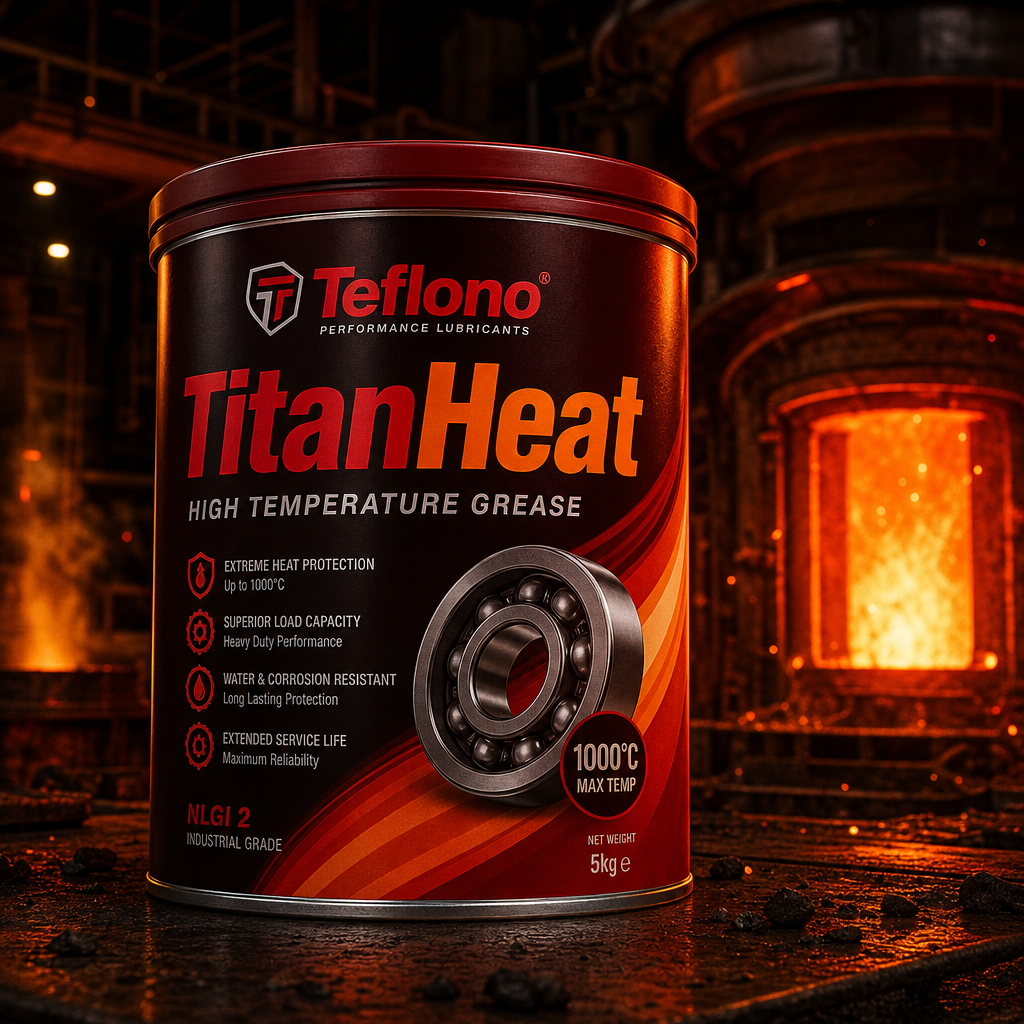
Teflono TitanHeat
Heavy-duty PFPE/PTFE grease with extreme load capacity for 265–295°C environments
TitanHeat combines a full perfluoropolyether (PFPE) base oil with a high-concentration sub-micron PTFE dispersion for environments demanding both extreme temperature resistance and heavy load carrying capacity. The polyurea thickener eliminates metallic soap limitations, offering exceptional shear stability with a drop point exceeding 325°C. A cerium-oxide nano-catalyst antioxidant system delivers superior oxidation stability that surpasses Krytox-class greases. Hydrophobic fumed silica provides very good water resistance. Designed for steel mill bearings, cement kiln applications, and heavy industrial equipment operating at sustained high temperatures.
Temp Range
265°C — 295°C
PTFE Content
24%
Base Oil
PFPE (Perfluoropolyether)
NLGI Grade
2
Technical Data Sheet
Specifications
Additives
Key Features
- PFPE base oil for maximum thermal stability up to 295°C
- 24% sub-micron PTFE content for heavy-load boundary lubrication
- CeO₂ nano-catalyst delivers superior oxidation stability exceeding Krytox class
- Polyurea thickener eliminates metallic soap limitations — drop point >325°C
- Hydrophobic fumed silica provides very good water resistance
- MoS₂ additive provides backup lubrication under extreme loads
- Exceptional shear stability for high-speed bearing applications
- Extended relubrication intervals reduce maintenance costs
Applications & Use Cases
Performance Characteristics
Manufacturing Recipe
Batch size: 1kg — Detailed formulation and step-by-step process
Ingredients (1kg batch)
| Ingredient | % | Grams | Role |
|---|---|---|---|
| PFPE Base Oil (Fomblin Y) | 40% | 400g | Base lubricant — fluorinated oil with extreme thermal stability to 340°C |
| Polyurea Thickener | 10% | 100g | Non-soap thickener — superior thermal and shear stability |
| PTFE Micro-powder (1μm sub-micron) | 24% | 240g | Solid lubricant — sub-micron grade for maximum film density and load bearing |
| Molybdenum Disulfide (MoS₂) | 5% | 50g | Backup solid lubricant for extreme pressure conditions |
| MDI (Methylene Diphenyl Diisocyanate) | 5% | 50g | Polyurea precursor — reacts with amines to form thickener |
| Octadecylamine | 3.5% | 35g | Polyurea precursor — forms urea linkage with MDI |
| Hydrophobic Fumed Silica | 3% | 30g | Moisture barrier agent — provides very good water resistance |
| Cerium Oxide Nano-catalyst (CeO₂) | 1.5% | 15g | Regenerative antioxidant catalyst — self-renewing oxygen scavenger for superior oxidation stability |
| Phenothiazine Anti-oxidant | 1.5% | 15g | High-temperature antioxidant synergist — works with CeO₂ above 280°C |
| Sulfurized EP Additive | 2.5% | 25g | Extreme pressure protection under shock loads |
| Benzotriazole Copper Passivator | 0.5% | 5g | Prevents copper corrosion in bronze bearings |
| Anti-foam Agent | 1% | 10g | Controls air entrainment |
| Hexagonal Boron Nitride (hBN) | 2% | 20g | Secondary solid lubricant — thermal conductor, fills surface asperities |
Process Steps
PFPE Oil Heating
Heat PFPE base oil (Fomblin Y) in a chemically inert vessel (PTFE-lined or glass). PFPE oils require careful handling — use only fluoropolymer-compatible seals and gaskets. Maintain nitrogen blanket throughout.
Polyurea Synthesis
Dissolve octadecylamine in half the PFPE oil at 70°C. Separately, dissolve MDI in the remaining PFPE oil at 50°C. Slowly combine the two solutions under vigorous agitation (1200 RPM). Exothermic reaction will occur — monitor temperature carefully.
Thermal Treatment
Heat the polyurea-PFPE mixture to drive the reaction to completion and develop the thickener structure. This step ensures the drop point exceeds 325°C. Maintain constant stirring. The mixture should develop a smooth, creamy consistency.
PTFE, MoS₂ & hBN Incorporation
Cool to 140°C. Pre-blend sub-micron PTFE (1μm), MoS₂, and hBN in a dry container. Add the dry blend slowly to the grease while agitating at 1500+ RPM. Then add hydrophobic fumed silica for water resistance. Continue mixing until fully homogeneous.
CeO₂ Nano-catalyst & Additive Addition
Cool to 110°C. Add cerium oxide nano-catalyst first — disperse at 1000 RPM for 5 minutes. CeO₂ provides regenerative antioxidant action for superior oxidation stability. Then add phenothiazine synergist, EP additive, copper passivator, and anti-foam agent.
Milling & Deaeration
Pass through a three-roll mill at tight clearances (0.02mm final gap) for ultra-smooth texture. Then deaerate under mild vacuum (500 mbar) for 15 minutes to remove trapped air.
Testing & Packaging
Perform full QC testing: penetration (265–295 dmm), drop point (>325°C), four-ball wear (<0.35 mm), oxidation stability (>480 min at 200°C — exceeds Krytox benchmark), and EP weld point (>350 kgf). Package in steel containers with nitrogen blanket.
Required Equipment
- PTFE-lined or glass-lined mixing vessel (2L)
- High-shear mixer (up to 1500+ RPM)
- Temperature controller with thermocouple
- Three-roll mill with adjustable gap
- Vacuum deaeration system
- Nitrogen gas supply for blanketing
- Analytical balance (0.01g precision)
- Oxidation stability bomb (ASTM D942)
- Full PPE: chemical-resistant gloves, respirator, face shield
Safety Notes
- MDI is a sensitizer and respiratory hazard — use in fume hood with appropriate respirator
- PFPE oils can decompose above 340°C releasing toxic fluorine compounds — do not overheat
- CeO₂ nano-particles are an inhalation hazard — handle in enclosed systems or fume hood
- MoS₂ dust is irritating — handle in well-ventilated area with dust mask
- Exothermic polyurea reaction requires careful temperature monitoring
- Keep water away from MDI — reacts violently with moisture
- Dispose of waste chemicals according to local hazardous waste regulations
Quality Control Checks
- Cone penetration: 265–295 dmm (ASTM D217)
- Drop point: >325°C (ASTM D2265) — exceeds all competitors
- Four-ball wear scar: <0.35 mm (ASTM D2266) — 12% better than Krytox
- Four-ball EP weld point: >350 kgf (ASTM D2596)
- Oxidation stability: >480 min at 200°C (ASTM D942) — exceeds Krytox benchmark (~350 min)
- Visual: Dark gray, smooth paste with no grit or separation